Agile Development: Frameworks, Principles & Practices
Written by Rohan Nandan on January 31, 2026 · 7 min read
Agile development represents a fundamental shift in how software teams approach building products. Rather than following rigid plans, agile embraces change and prioritizes delivering value to customers quickly and continuously.
Adapting Process Models
Every software project needs a roadmap or generic software process. However:
- Projects and teams vary widely
- No single software engineering framework is appropriate for every software product
- Any roadmap or generic process should be grounded in recognized industry practices
- Process models should be adapted to the current project context, team capability, and user needs
Principles for Organizing Software Projects
- It is risky to use a linear process model without ample feedback
- Comprehensive up-front requirements gathering is rarely possible or desirable
- Up-front requirements gathering may not reduce costs or prevent time slippage
- Appropriate project management is integral to software development
- Documents should evolve with the software and should not delay the start of construction
- Involve stakeholders early and frequently in the development process
- Testers need to become involved in the process prior to software construction
What is Agility?
Agility in software development encompasses:
- Effective (rapid and adaptive) response to change
- Effective communication among all stakeholders
- Integrating the customer into the team
- Organizing the team so that it controls the work performed
- Rapid, incremental delivery of software
Agility and the Cost of Change
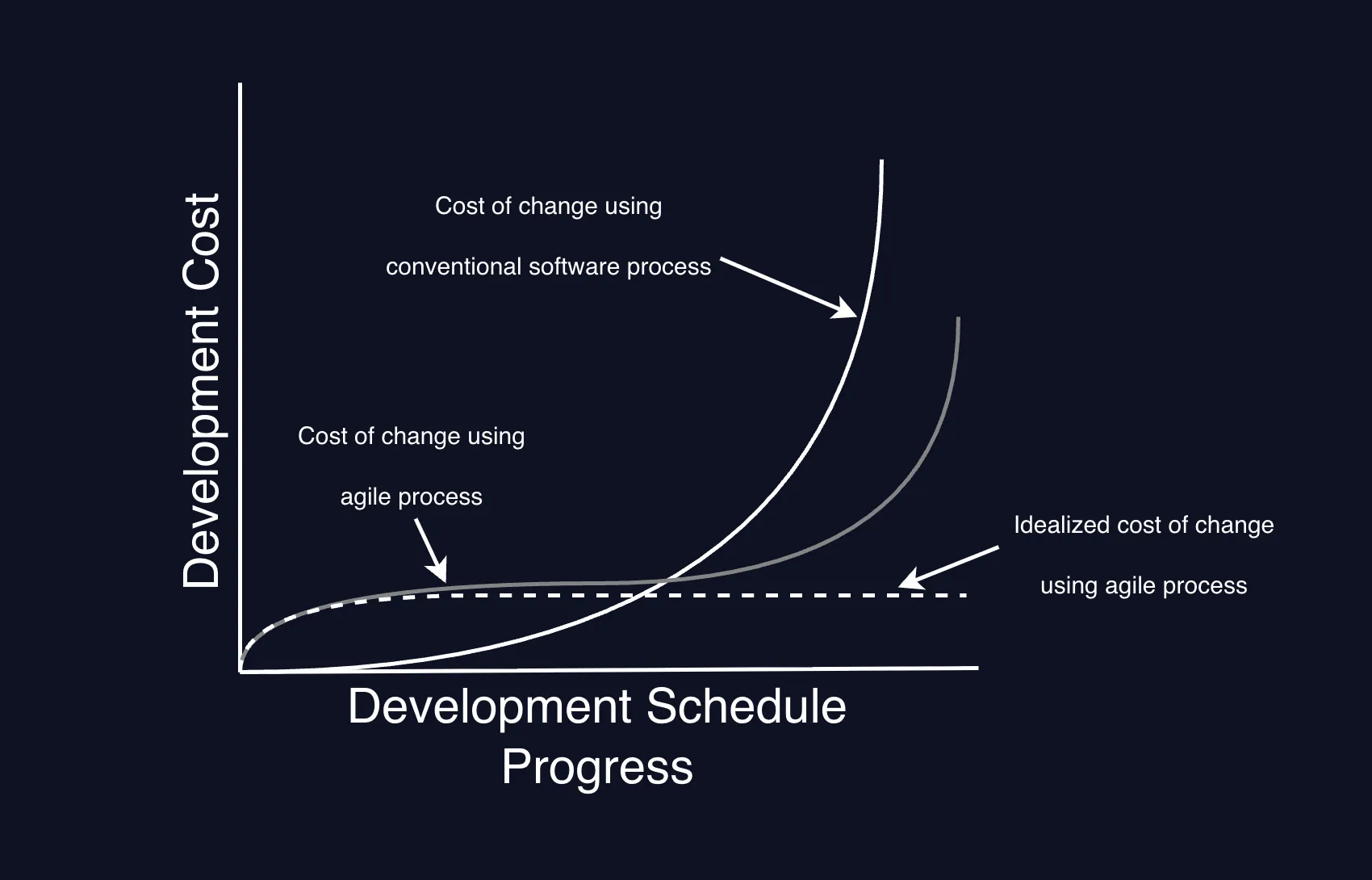
Traditional models assume that the cost of change increases exponentially as a project progresses. Agile methodologies aim to flatten this curve by embracing change at any stage through iterative development and continuous feedback.
What is an Agile Process?
An agile process is:
- Driven by customer descriptions of what is required (scenarios)
- Responsive to frequent customer feedback
- Recognizes that plans are short-lived
- Develops software iteratively with heavy emphasis on construction activities
- Delivers multiple software increments as executable prototypes
- Adapts as project or technical changes occur
Agility Principles
The core principles that guide agile development:
- Customer satisfaction is achieved by providing value through software delivered as rapidly as possible
- Developers recognize that requirements will change and welcome changes
- Deliver software increments frequently (weeks, not months) to ensure meaningful stakeholder feedback
- Agile teams are populated by motivated individuals using face-to-face communication
- Team process encourages technical excellence, good design, simplicity, and avoids unnecessary work
- Working software that meets customer needs is the primary goal
- Pace and direction must be sustainable, enabling effective long-term work
- An agile team is a self-organizing team trusted to develop well-structured architectures
- Team culture includes introspection aimed at improving effectiveness
Scrum Framework
Scrum is one of the most widely adopted agile frameworks, organizing work into time-boxed iterations called “sprints.”
Scrum Events
| Event | Description |
|---|---|
| Backlog Refinement | Developers work with stakeholders to create the product backlog |
| Sprint Planning | Backlog partitioned into sprints; next sprint defined |
| Daily Scrum | Team synchronizes activities and plans the workday (15 minutes max) |
| Sprint Review | Prototype demos delivered to stakeholders for approval or rejection |
| Sprint Retrospective | Team reflects on what went well and what needs improvement |
Pros
- Product owner sets priorities
- Team owns decision-making
- Documentation is lightweight
- Supports frequent updates
Cons
- Difficult to control the cost of changes
- May not be suitable for large teams
- Requires expert team members
Extreme Programming (XP) Model
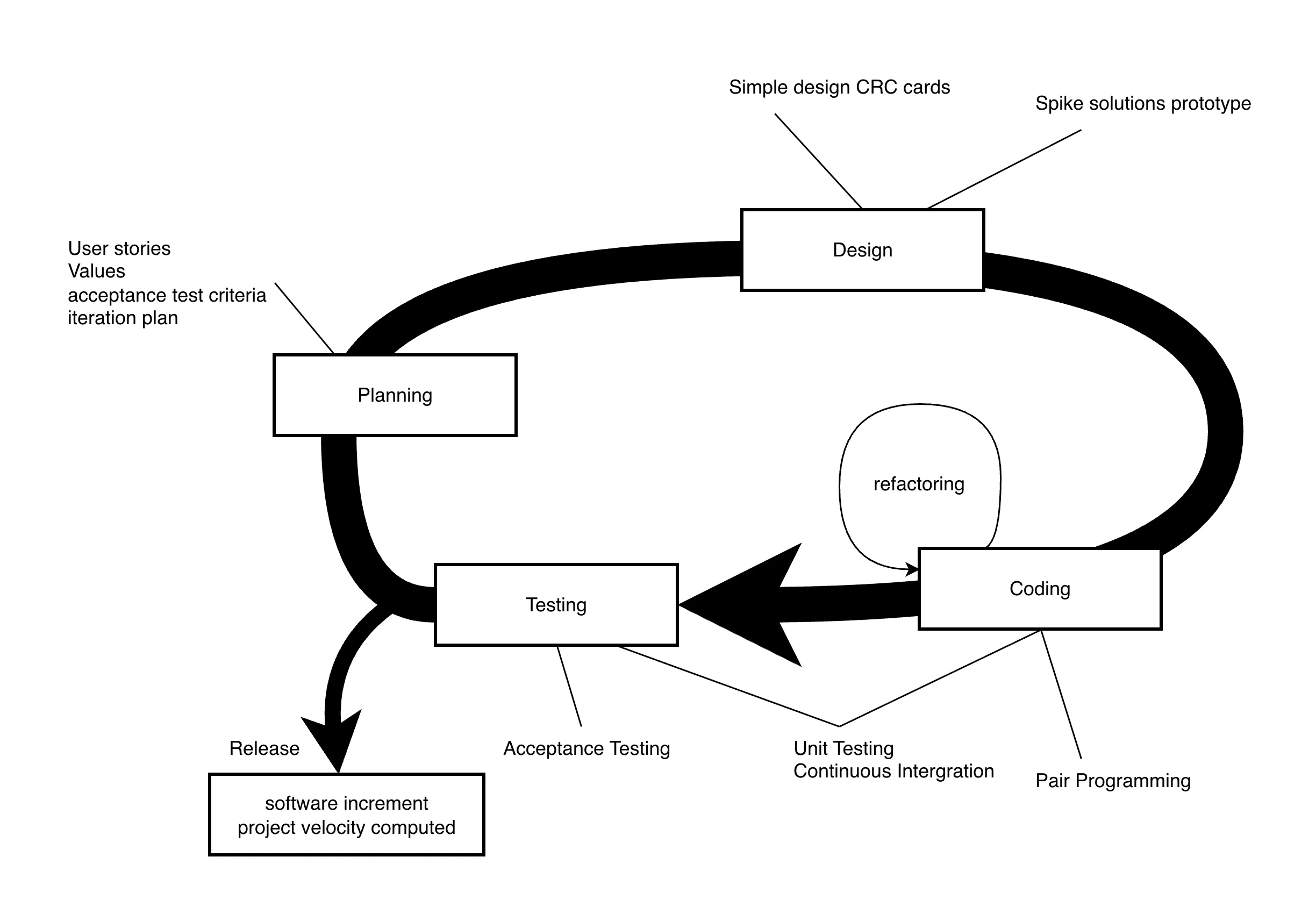
XP is an agile methodology that emphasizes technical practices and close collaboration with customers.
XP Practices
| Practice | Description |
|---|---|
| XP Planning | Begins with user stories; team estimates cost; stories grouped into increments; commitment made on delivery date; compute project velocity |
| XP Design | Follows KIS (Keep It Simple) principle; encourages CRC cards, design prototypes, and refactoring |
| XP Coding | Construct unit tests before coding; uses pair programming |
| XP Testing | Unit tests executed daily; acceptance tests defined by customer |
Pros
- Emphasizes customer involvement
- Establishes rational plans and schedules
- High developer commitment to the project
- Reduced likelihood of product rejection
Cons
- Risk of premature prototype release
- Requires frequent meetings (increasing coordination cost)
- Allows for excessive changes
- Depends on highly skilled team members
Kanban Framework
Kanban focuses on visualizing work and limiting work in progress to improve flow and efficiency.
Kanban Principles
- Visualizing workflow using a Kanban board
- Limiting work in progress at any given time
- Managing workflow to reduce waste by understanding current value flow
- Making process policies explicit and defining criteria for “done”
- Focusing on continuous improvement through feedback loops
- Making process changes collaboratively with all stakeholders
Pros
- Lower budget and time requirements
- Allows early product delivery
- Process policies written down
- Continuous process improvement
Cons
- Team collaboration skills determine success
- Poor business analysis can doom the project
- Flexibility can cause loss of focus
- Reluctance to use measurement
DevOps
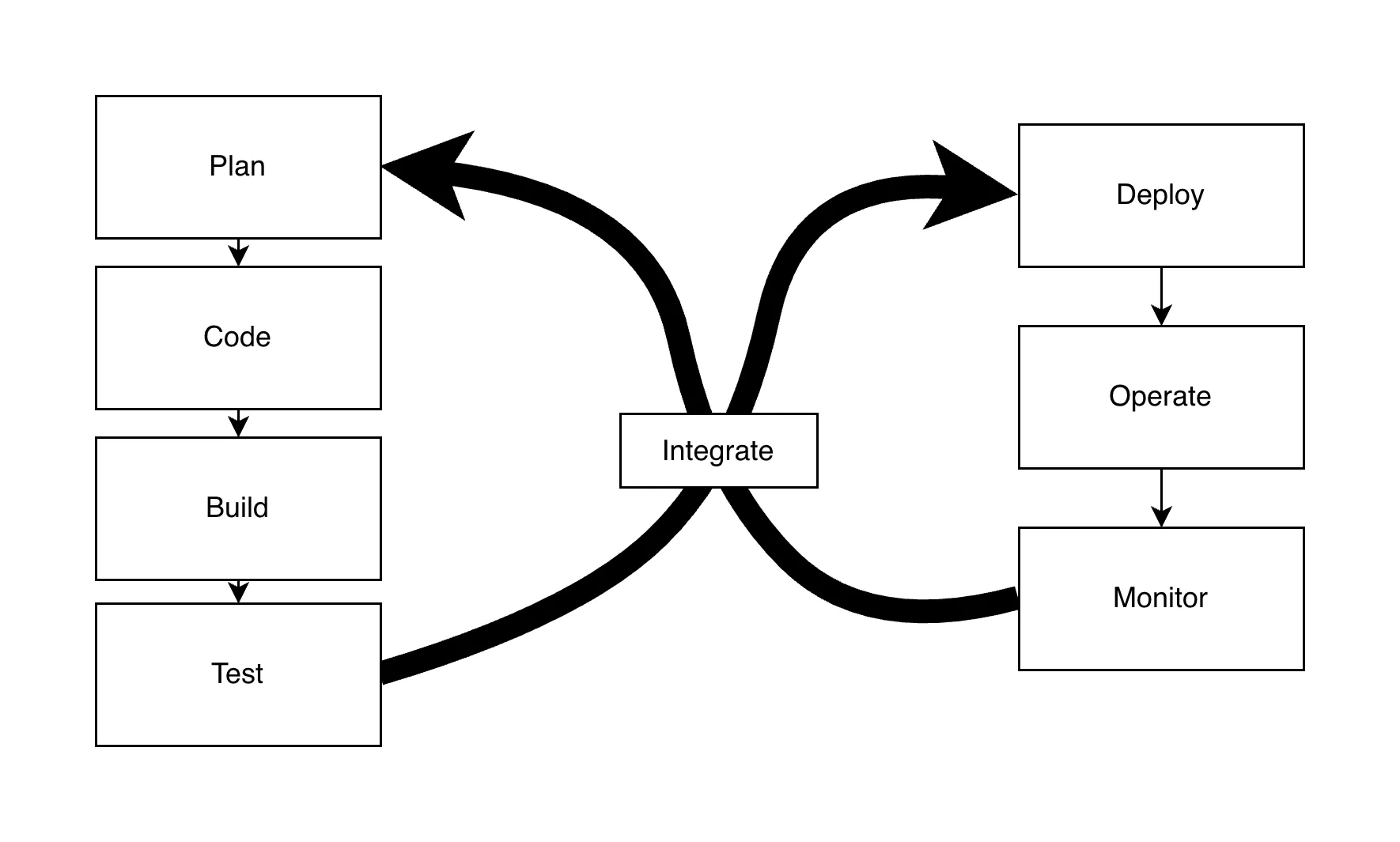
DevOps bridges the gap between development and operations, emphasizing automation and continuous delivery.
DevOps Pipeline
| Stage | Description |
|---|---|
| Continuous Development | Software delivered in multiple sprints |
| Continuous Testing | Automated testing tools used prior to integration |
| Continuous Integration | Code with new functionality added to existing running code |
| Continuous Deployment | Integrated code deployed to production environment |
| Continuous Monitoring | Operations staff proactively monitor software performance |
Pros
- Reduced time to code deployment
- Automated quality assurance
- Faster feedback loops
- Improved collaboration between teams
Cons
- Requires significant tooling investment
- Cultural shift required across the organization
- Security considerations at every stage
Agile Requirements Definition
Best practices for gathering and managing requirements in an agile environment:
- Encourage active stakeholder participation by matching their availability and valuing their input
- Use simple models (Post-it notes, fast sketches, user stories) to reduce barriers to participation
- Explain requirement representation techniques before using them
- Adopt stakeholder terminology and avoid technical jargon
- Use a breadth-first approach to get the big picture before diving into details
- Refine requirements “just in time” as user stories are ready to be implemented
- Prioritize features and implement the most important user stories first
- Collaborate closely with stakeholders and document requirements for future prototypes
- Question the need to maintain models and documents that are not referenced later
- Ensure management support for stakeholder and resource availability
Agile Architectural Design
Key elements for designing architecture in an agile context:
- Focus on key quality attributes and incorporate them into prototypes as constructed
- Successful products combine customer-visible features and the infrastructure needed to enable them
- Agile architectures enable code maintainability and evolvability through attention to architectural decisions
- Managing and synchronizing dependencies among functional and architectural requirements ensures the architecture is ready for future increments
Resource Estimation for Agile Projects
Estimating resources in agile requires balancing precision with adaptability:
- Use historic data to estimate the number of days needed to complete each user story
- Loosely organize user stories into sets for each planned sprint
- Sum the days to complete each sprint for a total project duration estimate
- Revise estimates as requirements are added or prototypes are delivered and accepted
Comparison: Agile Frameworks
| Framework | Best For | Key Strength | Key Weakness |
|---|---|---|---|
| Scrum | Teams needing structure within agility | Clear roles and ceremonies | Requires experienced Scrum Master |
| XP | Technical excellence focus | Strong engineering practices | High skill requirements |
| Kanban | Continuous flow work | Visual workflow management | Less structure for planning |
| DevOps | Rapid deployment needs | Automation and integration | Tooling complexity |
Characteristics of Agile Process Models
Key characteristics that define agile approaches:
| # | Characteristic |
|---|---|
| 1 | Not suitable for large high-risk or mission critical projects |
| 2 | Minimal rules and minimal documentation |
| 3 | Continuous involvement of testers |
| 4 | Easy to accommodate product changes |
| 5 | Depends heavily on stakeholder interaction |
| 6 | Easy to manage |
| 7 | Early delivery of partial solutions |
| 8 | Informal risk management |
| 9 | Built-in continuous process improvement |
Spiral Model Characteristics Recap
For reference, key points about the Spiral Model in relation to agile:
| # | Characteristic |
|---|---|
| 1 | Not suitable for small, low-risk projects |
| 2 | Several steps required, along with documentation done up front |
| 3 | Early involvement of testers (might be done by outside team) |
| 4 | Hard to accommodate product changes until prototype completed |
| 5 | Continuous stakeholder involvement in planning and risk assessment |
| 6 | Requires formal project management and coordination |
| 7 | Project end not always obvious |
| 8 | Good risk management |
| 9 | Process improvement handled at end of project |
These agile frameworks and practices support selection and adaptation of methodologies to project context, team capability, and organizational culture.