SDLC as a System: Framework Activities, Umbrella Activities, and Process Principles
Written by Rohan Nandan on January 22, 2026 · 14 min read
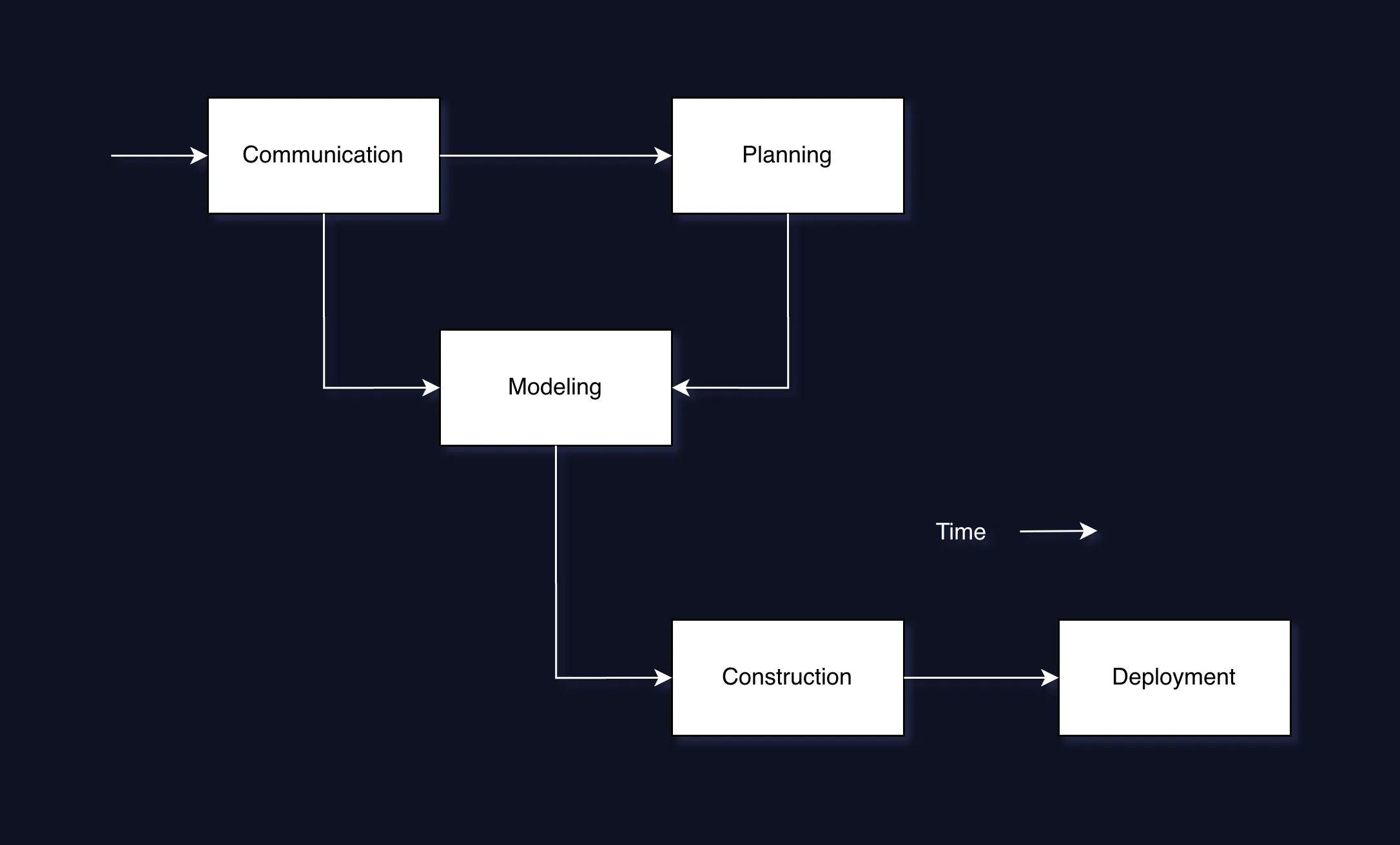
The Software Development Life Cycle (SDLC) is not just a checklist of phases. It is a structured system for turning uncertain requirements into dependable software through coordinated technical and management activities.
Why SDLC Exists
Many software failures trace back to the same patterns:
- unclear or missing requirements,
- skipped lifecycle activities,
- unmanaged scope and planning,
- and inability to adapt to technology change.
SDLC provides a disciplined response by defining what work happens, when it happens, and what outputs must exist before progression.
Each of these four failure patterns represents a different way that “just start coding” breaks down on anything beyond a trivial project. Unclear or missing requirements mean the team may be building the wrong thing efficiently, which is often worse than building the right thing slowly. Skipped lifecycle activities — a review that never happens, testing that gets compressed to make a deadline — remove exactly the checkpoints that would have caught a problem while it was still cheap to fix. Unmanaged scope and planning let small, individually reasonable additions accumulate into a project that no longer resembles what was originally estimated or approved. Inability to adapt to technology change leaves a team maintaining decisions made under assumptions that no longer hold. SDLC exists specifically to counter these four patterns by making the sequence of work, and the outputs each stage must produce before the next one starts, explicit rather than left to whatever the team happens to remember to do.
Framework Activities
A widely used process framework includes the following core activities:
- Communication - understand stakeholder goals, constraints, and expectations.
- Planning - define timeline, resources, scope boundaries, and quality approach.
- Modeling - analyze requirements and create design abstractions.
- Construction - implement and verify through coding and testing.
- Deployment - deliver software to users and operate in target context.
- Maintenance - evolve and sustain software after release.
Each activity should produce work products that are reviewable and useful to downstream work.
This generic framework — communication, planning, modeling, construction, and deployment, with maintenance carrying the product forward afterward — is deliberately written at a level general enough to apply across different process models, from a strict waterfall sequence to a heavily iterative agile cycle; the same five core activities simply recur at a different frequency and granularity depending on the model chosen [1]. Communication comes first because every other activity depends on an accurate understanding of what is actually being asked for — planning against the wrong goal, or modeling requirements no one actually stated, wastes effort regardless of how well-executed those later activities are. Planning translates that understanding into commitments: a timeline, a resourcing plan, and boundaries on what is and is not in scope, all of which the rest of the project will be measured against. Modeling is where abstract requirements become concrete design decisions — data structures, architecture, interfaces — that construction can actually be built from. Construction and deployment are where the design becomes a running system that real users depend on, and maintenance is the recognition that the activity does not stop there. Requiring each activity to produce a reviewable work product, rather than treating it as an internal mental step, is what makes the framework auditable — someone other than the person who did the work can check whether it was actually done.
Umbrella Activities
Framework activities are supported by umbrella activities that span the lifecycle:
- project tracking and control,
- risk management,
- software quality assurance,
- technical reviews,
- measurement and analytics,
- configuration management,
- reusability management,
- and work-product preparation.
Without umbrella activities, teams may still produce code but lose control over consistency, quality, and change history.
These are called “umbrella” activities precisely because none of them belongs to a single phase — they run continuously alongside communication, planning, modeling, construction, and deployment rather than occupying a slot of their own in the sequence. Project tracking and control gives the team a continuous, current picture of where the project actually stands relative to the plan, rather than only finding out at a milestone. Risk management and technical reviews both function as early-warning systems, but from different angles — risk management looks ahead at what could go wrong, while technical reviews check what has already been built against the standards it is supposed to meet. Software quality assurance and measurement and analytics turn “we think this is good” into something verifiable, using defined criteria and collected data rather than impression. Configuration management is what keeps a fast-moving project from losing track of which version of what artifact is actually current, which becomes critical the moment more than one person is changing the same codebase. Reusability management and work-product preparation round this out by making sure existing components are identified and reused where sensible, and that every artifact the project produces is actually usable by the people who need it next. A team that ignores these activities does not stop producing code — code is exactly what “just start coding” still produces — but it does lose the connective tissue that keeps that code consistent, quality-checked, and traceable over time.
Task Sets and Operational Clarity
A task set translates high-level lifecycle activities into executable work:
- tasks to perform,
- artifacts to produce,
- quality filters to apply.
This matters because vague phase labels alone do not guarantee execution quality. Task sets make responsibilities explicit and enable auditable progress.
A phase label like “planning” or “modeling” tells a team what category of work is happening, but it does not, by itself, tell any individual what to actually do today — that is the gap a task set closes. Breaking a phase down into specific tasks means someone can be assigned a concrete, checkable unit of work rather than an open-ended responsibility. Specifying the artifacts each task must produce means completion is defined by an actual deliverable existing, not by someone’s sense that they have “mostly” finished. Quality filters attached to each task set the bar that deliverable has to clear before it is considered genuinely done, rather than merely produced. Together, these three elements are what let a project manager or a teammate audit progress honestly — a project that can only report progress at the level of “planning is underway” is far less controllable than one that can report exactly which tasks and artifacts remain outstanding within that phase.
Process Principles That Guide Execution
Effective process behavior includes:
- be agile in response to change,
- keep quality as an exit condition for every activity,
- adapt process to project constraints,
- build effective self-organizing teams,
- establish strong communication and coordination,
- manage change with explicit mechanisms,
- assess risk continuously,
- and produce only work products that provide downstream value.
These principles prevent process dogma and keep process tied to delivery outcomes.
These principles are best read as guardrails against following a process model too literally, rather than as an alternative process in their own right. Being agile in response to change and adapting process to project constraints both push back against the idea that any single, named model should be applied identically to every project regardless of its specific circumstances. Keeping quality as an exit condition for every activity — not just for testing at the end — is what prevents “we’ll fix it later” from becoming the default response to a defect discovered mid-phase. Building effective self-organizing teams and establishing strong communication and coordination recognize that a process on paper only works as well as the people executing it choose to make it work, so the principles put explicit weight on team dynamics rather than treating process as a purely mechanical structure. Managing change with explicit mechanisms and assessing risk continuously extend the same discipline discussed earlier in project planning across the entire lifecycle rather than confining it to an upfront planning phase. Producing only work products that provide downstream value is a direct check against process becoming its own justification — a document or artifact that no one downstream actually uses is overhead the process should shed, not evidence of thoroughness.
Practice Principles for Technical Work
At implementation level, process quality depends on practice quality. Core practice principles include:
- divide and conquer through separation of concerns,
- use abstraction intentionally,
- maintain consistency,
- design interfaces for reliable information transfer,
- enforce modularity,
- identify reusable patterns,
- model from multiple viewpoints,
- and design for future maintainers.
These principles lower cognitive load and reduce defect propagation.
Separation of concerns is one of the oldest and most foundational ideas in this list — the term itself was coined by Edsger Dijkstra, who argued that a complex problem becomes tractable specifically by dealing with one relevant aspect of it at a time rather than all of its qualities simultaneously [2]. Modularity is the most common concrete expression of that same principle applied to code structure: each module encapsulates a single concern and can be understood largely in isolation, which is what keeps a large system from becoming something no individual engineer can hold in their head at once [3]. Abstraction works alongside modularity by letting an engineer reason about what a component does without needing to track how it does it internally, which is exactly what makes large systems navigable rather than an undifferentiated mass of detail. Designing interfaces for reliable information transfer matters because most defects in a modular system emerge at the boundaries between modules rather than inside any single one — a module can be internally correct and still cause failures if the assumptions on either side of its interface do not match. Maintaining consistency reduces the number of special cases a future reader has to remember, and modeling from multiple viewpoints — for instance, a data view versus a control-flow view of the same system — surfaces issues that are invisible from any single perspective alone. Designing for future maintainers closes the loop with the maintenance-dominant cost reality discussed elsewhere in this series: nearly every one of these principles pays off specifically in how cheaply the system can be understood and safely changed long after it was first written, not just in how it behaves on day one.
Communication and Planning as Continuous Activities
SDLC is often taught as linear, but in practice it is iterative:
- communication should be prepared, facilitated, documented, and collaborative,
- planning should be iterative, risk-aware, and continuously tracked,
- granularity should increase as knowledge improves.
This matters because software projects rarely fail in a single step; they drift through unmanaged daily deviations.
Treating communication as something to be prepared and facilitated, rather than assumed to happen naturally, acknowledges that a productive stakeholder conversation is itself a skill and an activity, not a byproduct of simply being in the same room. Documenting that communication is what prevents two people from walking away from the same conversation with two different understandings of what was agreed. Planning being iterative and continuously tracked, rather than fixed once at the project’s start, mirrors the same iterative principle already covered for planning specifically — as the project learns more, the plan should absorb that new information rather than remaining a static artifact everyone quietly knows is out of date. Increasing granularity as knowledge improves is the practical mechanism for that iteration: it makes little sense to plan distant future work down to the day when the team’s understanding of that work is still coarse, so detail is added progressively as the relevant phase gets closer and better understood. The reason this matters as much as it does is captured directly in the last point — few real project failures trace back to one dramatic, single decision; far more often, a project drifts off course through many small, individually unremarkable deviations that were never caught because no one was tracking communication and planning as living, ongoing activities.
Construction, Testing, and Deployment Discipline
Lifecycle integrity requires explicit engineering discipline:
- coding follows design constraints and validation practices,
- testing is traceable to requirements and begins early,
- deployment manages support readiness and user expectations.
A practical rule remains useful: release quality first; do not normalize delivering known-critical defects.
Coding following design constraints means construction is treated as the execution of decisions already made during modeling, not an opportunity to silently redesign the system ad hoc at the keyboard — deviating from the design without updating it is how the design documentation and the actual system quietly drift apart. Testing being traceable to requirements means every test exists because it verifies something the system was actually supposed to do, which is also what makes it possible to know, with confidence, which requirements have and have not been validated. Testing beginning early rather than being compressed into a single late phase is what allows defects to be caught while the context needed to fix them cheaply — the reasoning behind a recent design decision, for instance — is still fresh. Deployment managing support readiness and user expectations recognizes that a technically working release can still fail operationally if the people who will support it are unprepared, or if users were never told what to expect from the new system. The rule against normalizing known-critical defects exists because the alternative — quietly shipping a known serious issue to hit a date — tends to become easier to justify every time it is done once, which is exactly the kind of small, repeated deviation the earlier section warned drifts a project toward failure.
Layered Technology Perspective
Another useful framing is software engineering as layered technology:
- quality focus,
- process,
- methods,
- tools.
SDLC operates inside this structure. Process provides the skeleton; methods and tools provide execution capability; quality focus provides direction.
This layered framing is a well-established one in software engineering education, most closely associated with Pressman’s textbook treatment of the discipline, which places quality focus as the base layer that everything else rests on, with process, methods, and tools built on top of it [4]. Quality focus sits at the foundation because an organizational commitment to quality is what gives the other three layers their purpose — process, methods, and tools applied without that commitment can still produce software, just not necessarily good software. Process is described as the layer that holds the other technology layers together, defining the framework of activities — the same communication, planning, modeling, construction, and deployment activities discussed earlier — that give methods and tools an order and a context in which to operate [5]. Methods provide the technical “how-to” for the tasks within that process — the specific techniques used for requirements analysis, design, or testing — while tools provide automated or semi-automated support for carrying those methods out efficiently, and become especially powerful when integrated so that output from one tool can feed directly into another. Seeing SDLC as operating specifically within the process layer of this larger structure clarifies why an SDLC framework alone is not sufficient on its own: it organizes the sequence of activities, but methods still need to be chosen for each activity, tools still need to be selected to support them, and a quality focus still needs to be actively maintained underneath all of it for the whole structure to function as intended.
Conclusion
SDLC should be treated as an integrated management-and-engineering system, not a static phase diagram. Framework activities organize work, umbrella activities protect continuity, and principles guide adaptation under uncertainty. Teams that understand SDLC at this system level are better equipped to deliver software that is not only functional at launch but sustainable over time.
Taken as a whole, the pieces covered here are not independent checklists to satisfy separately — they are different views of the same underlying discipline. Framework activities answer what work happens and when; umbrella activities answer what keeps that work consistent and trustworthy as it happens; task sets answer how any of it becomes concrete enough to actually execute and audit; and process and practice principles answer how to keep all of it honest under the pressure and uncertainty that real projects always introduce. A team that only memorizes the phase names of SDLC, without understanding how these layers of structure reinforce each other, tends to produce exactly the kind of software that looks complete at launch and becomes increasingly unmanageable soon after — which is the outcome this entire system exists to prevent.
References
- SlideShare — Software Engineering Layered Technology & Software Process Framework
- Wikipedia — Separation of concerns
- SlideShare — Design Concepts, Unit 4 (Pressman) — Separation of Concerns and Modularity
- Medium — Unveiling the Layers of Software Engineering: Lessons from Pressman and Maxim
- SlideToDoc — Layered Approach: Process, Methods and Tools, Quality Focus