The Software Crisis Revisited: Quality Attributes, Failure Patterns, and Professional Ethics
Written by Rohan Nandan on April 21, 2026 · 11 min read
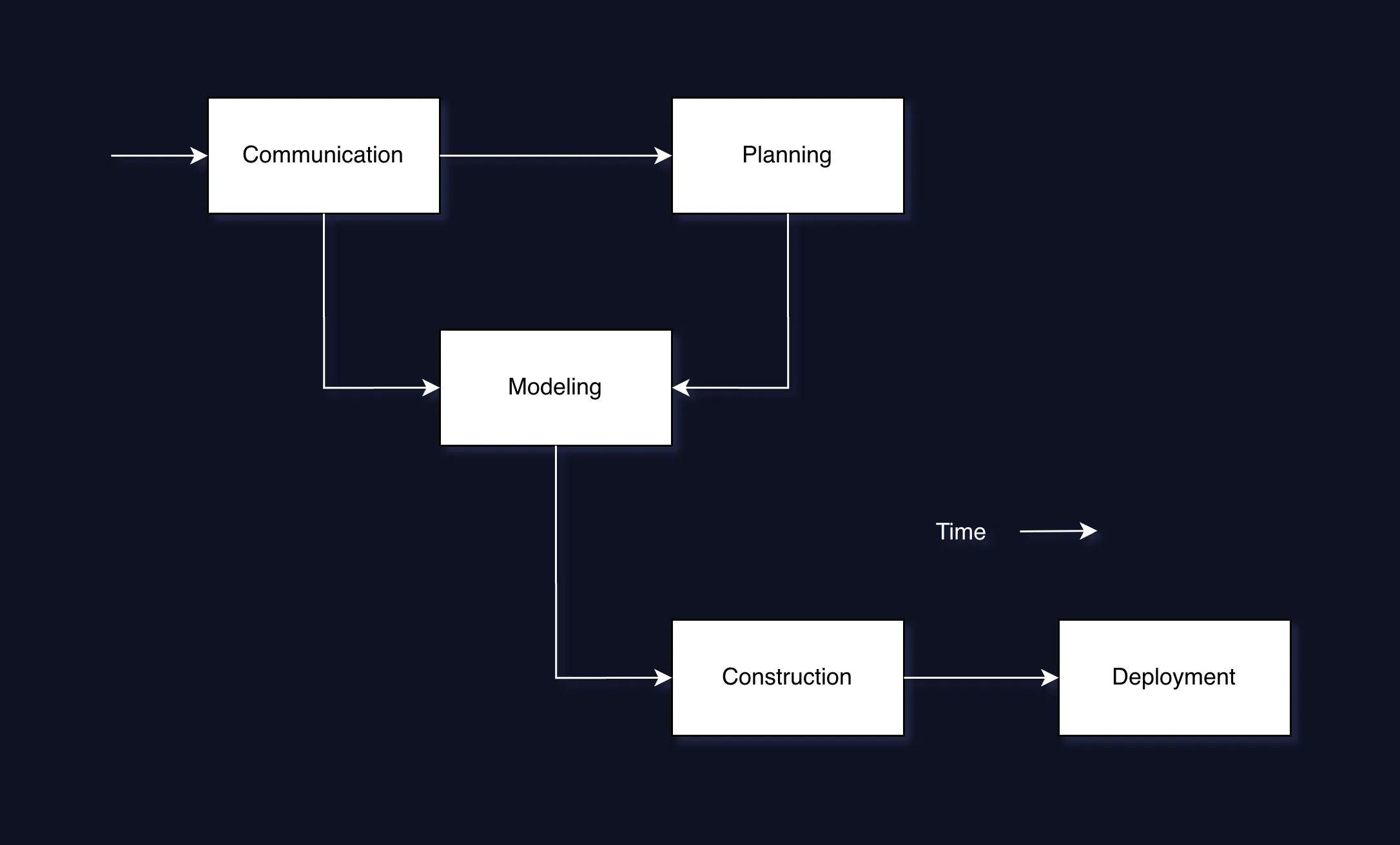
The term software crisis describes a recurring gap between software demand and our ability to deliver high-quality systems on time and within budget. Although tools and methods have improved, the underlying causes remain relevant: complexity rises faster than discipline.
What the Software Crisis Means
Software crisis is not one failure event. It is a persistent pattern where project complexity outgrows the development method, management control, or organizational communication in use.
Typical outcomes include:
- schedule overrun,
- budget overrun,
- reduced quality,
- and in severe cases, cancellation.
Observed outcomes show a sobering distribution: a minority of projects complete on time and within budget, while many slip or are terminated.
The phrase itself has a specific origin worth understanding. It was coined by attendees at the first NATO Software Engineering Conference, held in Garmisch, Germany in 1968, at a moment when rapidly increasing computer power was making it possible to attempt far more ambitious systems than existing development practices could reliably deliver [1]. The problem was not a shortage of programming talent; it was that techniques suited to small, simple programs did not scale to the much larger, interdependent systems organizations were now attempting to build [2]. Because that gap between ambition and method has never fully closed, the term has stayed useful well beyond the 1960s and 1970s — each new wave of technical capability tends to reopen a version of the same crisis until practice catches up.
Symptoms and How Teams Track Them
Crisis symptoms become visible long before a project fails completely:
- Over-budget execution
- Schedule slippage
- Poor quality and stakeholder dissatisfaction
These symptoms are measurable. Teams commonly use:
- S-curves for planned versus actual cost trends,
- Gantt or milestone tracking for schedule control,
- Earned Value metrics and defect/customer feedback indicators for delivery quality.
Measurement does not remove risk by itself, but it creates early warning signals and supports corrective action.
Over-budget execution is rarely the result of one large miscalculation; it typically accumulates from many small underestimates and unplanned scope additions that only become visible in aggregate once tracked against a baseline. Schedule slippage behaves the same way, which is why milestone tracking matters more than tracking the final deadline alone — a project can look on schedule right up until a late milestone reveals that several earlier ones were quietly missed. Poor quality and stakeholder dissatisfaction are the hardest symptoms to catch early because they are qualitative by nature, which is exactly why teams pair them with quantitative proxies like defect counts and customer feedback scores. None of these tracking tools prevent a crisis on their own — an S-curve does not fix an overrun, and a Gantt chart does not repair a broken schedule — but together they convert a crisis from something a team discovers at the deadline into something a team can see coming and respond to while there is still time to act.
Core Causes
Two root causes remain central in practice:
- Communication breakdown among stakeholders, developers, and decision-makers.
- Complexity mismanagement as scope, dependencies, and constraints scale.
Most project failures are not caused by a single technical bug. They emerge from compounded management, communication, and architectural decisions.
Communication breakdown is especially damaging because software requirements live in people’s heads before they live in any document, and every handoff between a stakeholder, a developer, and a decision-maker is an opportunity for that understanding to drift. A requirement that seemed obvious to the person who stated it can be interpreted completely differently by the person who implements it, and that gap often is not discovered until the software is demonstrated and does not match what was expected. Complexity mismanagement compounds this problem rather than existing separately from it: as scope, dependencies, and constraints scale, the number of people who need a shared, accurate understanding of the system also scales, which means the same communication gaps that were tolerable on a small project become far more costly on a large one. This is why the historical software crisis was first noticed on large, ambitious systems rather than small ones — scale exposes weaknesses in communication and control that a small, single-developer project can often get away with ignoring.
Quality Attributes as Anti-Crisis Controls
A strong way to reduce software crisis risk is to treat quality attributes as first-class requirements:
- Maintainability: software must evolve as business changes.
- Dependability and security: failures should not create unacceptable economic or physical damage.
- Efficiency: systems should use memory, processing, and latency budgets responsibly.
- Acceptability: software must be understandable, usable, and compatible with user context.
If these qualities are deferred until late testing, cost of correction grows sharply.
Treating these attributes as first-class requirements means writing them down and designing for them from the start, the same way a functional requirement would be — not leaving them as implicit assumptions that only get checked once the system is nearly finished. Maintainability protects a project against exactly the kind of complexity mismanagement described above, since a system that is easy to change safely absorbs new requirements without destabilizing what already works. Dependability and security matter most in exactly the situations a software crisis tends to produce: a rushed, under-tested system delivered under schedule pressure is precisely the kind of system likely to fail in ways that cause real economic or physical harm. Efficiency failures often surface as performance complaints late in a project, at which point fixing them can mean redesigning core parts of the architecture rather than tuning a few settings. Acceptability is the attribute most directly tied to the “poor quality and stakeholder dissatisfaction” symptom described earlier — a system can meet every functional requirement and still be experienced as a failure if the people using it cannot understand or comfortably operate it. Deferring any of these until late testing is expensive precisely because defects found late usually require touching architecture-level decisions that were made early, which is far costlier to unwind than it would have been to get right from the outset.
Ethics vs Law in Software Practice
A critical distinction is that law sets minimum enforceable standards, while ethics guides professional judgment beyond legal compliance.
- Legal compliance answers: “Is this permitted?”
- Ethical practice answers: “Is this responsible and defensible?”
In software engineering, many harmful decisions are legal but still professionally negligent, especially where safety, fairness, privacy, or transparency is involved.
Law and ethics operate on different timelines relative to technology. Legislation is typically written in response to harms that have already occurred, which means it tends to lag behind the current capabilities of software — a practice can be entirely legal simply because no law has yet been written to address it, not because it is harmless. Ethics is meant to fill that gap by asking a broader question than compliance: not “has this been prohibited yet,” but “would a responsible professional be comfortable defending this decision if its consequences became public.” This is why the distinction matters in practice rather than just in theory — a team that only asks whether something is legally permitted will make decisions that a later inquiry, lawsuit, or public reaction judges as clearly negligent, even though no law was technically broken at the time.
Professional Responsibility Areas
Four recurring responsibility areas:
- Confidentiality - protect client/employer information.
- Competence - do not misrepresent skill level or accept work far outside capability without support.
- Intellectual property rights - respect ownership, licenses, patents, and copyrights.
- Computer misuse - do not weaponize technical skill for abuse, sabotage, or unauthorized access.
These are practical operating constraints, not abstract values.
Confidentiality exists because software engineers routinely have access to information — business logic, user data, security architecture — that could cause real harm to a client or employer if mishandled, so protecting it is a professional obligation rather than a courtesy. Competence is about honesty regarding one’s own limits: accepting or continuing work that is genuinely beyond one’s current skill, without seeking support or disclosing the gap, puts the eventual users of that software at risk in ways that are hard for anyone outside the project to detect until something fails. Intellectual property rights matter because software is built on a dense stack of other people’s work — libraries, frameworks, prior designs — and respecting ownership, licensing, and copyright is what keeps that reuse ecosystem functional and legal for everyone. Computer misuse is the most direct of the four: technical skill that can build systems can also break or exploit them, and the same knowledge that makes someone a capable engineer is what would make them dangerous if turned toward abuse, sabotage, or unauthorized access. Framing these as practical operating constraints rather than abstract values is deliberate — they are the kind of everyday judgment calls a working engineer actually faces, not distant philosophical positions.
ACM/IEEE Software Engineering Code of Ethics
The ACM/IEEE ethical framework organizes obligations across eight domains:
- Public interest
- Client and employer interest (within public interest)
- Product quality and standards
- Independent professional judgment
- Ethical management
- Integrity of the profession
- Fairness to colleagues
- Lifelong learning and ethical self-development
This structure is useful because it resolves conflicts that teams face daily, such as speed versus safety or profitability versus transparency.
This code was developed jointly by the IEEE Computer Society and the ACM through a dedicated task force on software engineering ethics and professional practices, and it was formally adopted as a standard for the profession rather than left as informal guidance [3]. A deliberate design choice in the code is its ordering: the Public principle was placed first, ahead of Client and Employer, so that when a software engineer’s obligation to their employer conflicts with the wider public interest, the code is explicit that public interest takes precedence [4]. That ordering is what gives the framework its practical use in resolving daily conflicts — when speed pressure from a client collides with a safety concern, or when profitability collides with the need for transparency, the code does not leave the engineer to guess which obligation should win; it establishes a hierarchy in advance, so the hard case has already been thought through before it arises in the middle of a project.
Why Ethics Is Also a Quality Mechanism
Ethical discipline improves engineering outcomes:
- Better transparency reduces hidden risk.
- Honest estimation improves planning fidelity.
- Respect for competence boundaries reduces avoidable defects.
- Responsible handling of security and privacy reduces downstream legal and reputational cost.
In this sense, ethics is not separate from quality. It is one of the conditions that makes quality possible.
Better transparency reduces hidden risk because problems that are surfaced early can be planned around, while problems that are hidden or minimized to avoid uncomfortable conversations tend to resurface later, at a point when they are harder and more expensive to fix. Honest estimation improves planning fidelity in the same way estimation reliability was discussed earlier in the planning process — an estimate inflated with optimism to please a stakeholder is not really an estimate at all, and every downstream schedule and budget decision built on it inherits that dishonesty. Respect for competence boundaries reduces avoidable defects because most serious defects trace back to someone working past the edge of what they actually understood well, without flagging that gap to anyone who could help close it. Responsible handling of security and privacy reduces legal and reputational cost precisely because those two categories of harm — a data breach, a privacy violation — are exactly the kind of failure that can outlast the project itself and damage an organization’s standing long after the original deadline pressure that caused the shortcut has been forgotten. Seen this way, ethics is not a constraint bolted on top of engineering quality; it is one of the underlying conditions that determines whether quality, once achieved, actually holds up over time.
Conclusion
The software crisis persists wherever complexity exceeds discipline. Technical methods matter, but they are insufficient without strong communication, measurable quality controls, and professional ethics. Projects become more reliable when teams treat quality attributes and ethical obligations as integral design constraints from the start, rather than as post-failure corrections.
The throughline across all of this is that a software crisis, whether in 1968 or today, is rarely a single dramatic failure — it is the accumulated result of many small deferred decisions: a requirement left ambiguous, a quality attribute postponed to “later,” an ethical shortcut taken under deadline pressure. None of these individually looks like a crisis in the moment. The frameworks discussed here — measurable symptoms, quality attributes treated as requirements, and a structured code of ethics — exist precisely to catch those small deferred decisions before they compound into the kind of failure the term was originally coined to describe.
References
- Wikipedia — Software crisis
- University of Cape Town — The software crisis
- IEEE Computer Society — Code of Ethics for Software Engineers
- Academia.edu — Software engineering code of ethics is approved (Gotterbarn, Miller & Rogerson, Communications of the ACM, 1999)